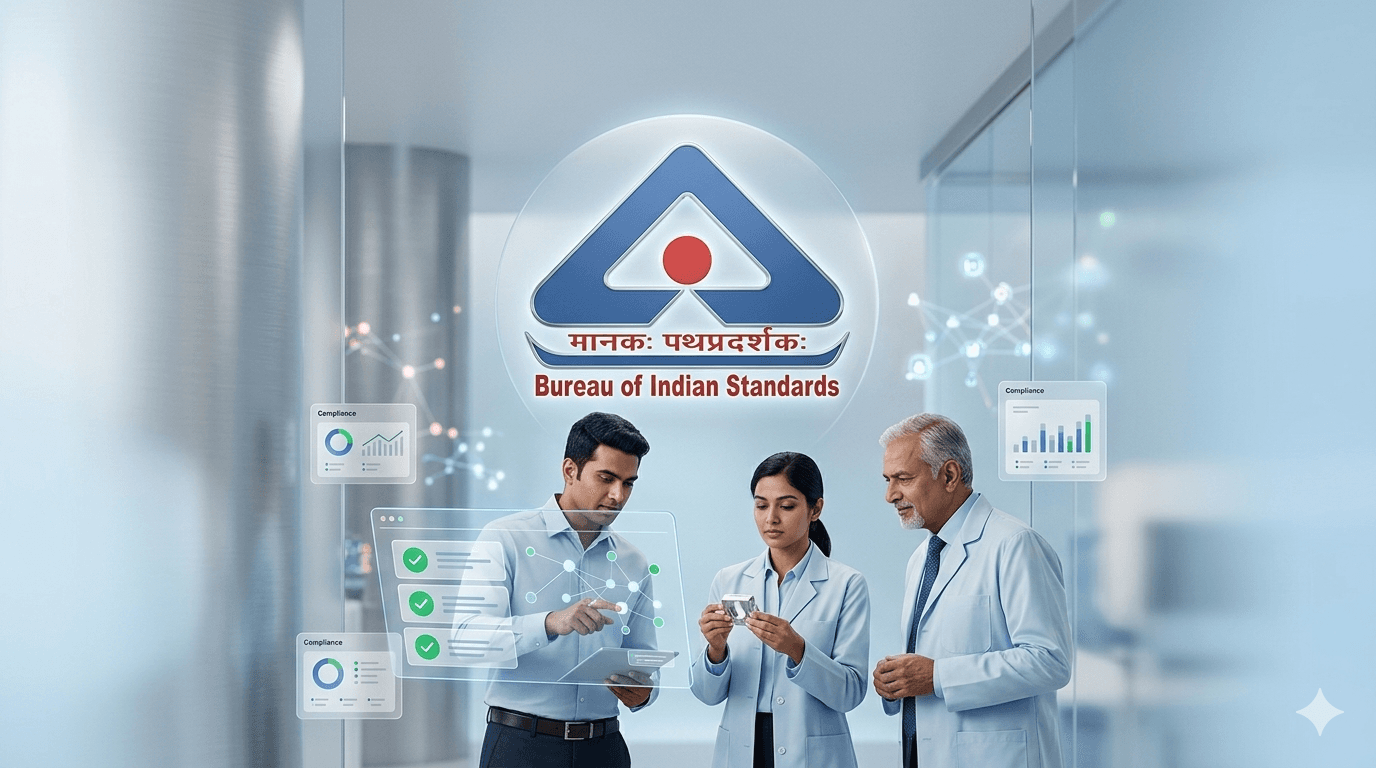
ISI Mark Certification,
Handled for You
The ISI Mark is India's most recognized quality certification mark, administered by the Bureau of Indian Standards (BIS). It is mandatory for 370+ product categories under various Quality Control Orders. Products without the ISI Mark cannot be legally manufactured or sold in India.
Our BIS specialists coordinate with BIS-recognized labs, prepare your complete license application, guide factory inspection preparation, and follow up until your ISI Mark license is granted — typically in 8–12 weeks.

Who Needs ISI Mark?
370+ categories of goods manufactured or sold in India require mandatory ISI Mark certification.
Steel & Iron Products
Reinforcement bars, mild steel tubes, galvanized steel sheets and structural steel sections all require ISI Mark certification.
Cement & Building Materials
Portland cement, fly ash bricks, ceramic tiles, sanitary ware and building hardware require mandatory ISI certification.
Electrical Goods
Domestic wiring cables, switches, plug sockets, MCBs, transformers and electrical motors require mandatory ISI Mark.
Pressure Cookers & Cookware
Pressure cookers, cylinders, and LPG-related products must carry the ISI Mark before being sold in India.
Water Pipes & Fittings
PVC pipes, CPVC fittings, water meters, and related plumbing materials require ISI certification for quality assurance.
Safety Equipment
Helmets (industrial and two-wheeler), safety shoes, fire extinguishers, and protective gear require mandatory ISI Mark.
Importance & Benefits of ISI Mark Certification
The ISI Mark is far more than a compliance checkbox — it is India's gold standard for product quality, a gateway to government procurement, and a shield against market penalties and seizure.
Legal Right to Manufacture & Sell
Only ISI Mark-certified products can be legally manufactured, imported, or sold in India for the 370+ categories under Quality Control Orders. The CM/L number stamped on the product proves BIS compliance.
Factory Inspection Builds Process Credibility
Unlike CRS, the ISI Mark involves a BIS factory audit, which validates your manufacturing process and quality system — building credibility with B2B buyers, government tenders, and retailers.
India's Most Trusted Quality Mark
The ISI Mark has been in use since 1955 and is the most widely recognized quality symbol in India. Consumer trust in ISI-marked products is extremely high, directly impacting sales and brand positioning.
Access to Government Tenders & PSU Orders
Most government procurement, defence, railways, and public sector orders mandate ISI-certified products. Without ISI Mark, your products are disqualified from a significant portion of India's institutional market.
Protection Against Market Seizure & Penalties
Non-ISI products are routinely seized during market surveillance by BIS and state enforcement agencies. ISI certification eliminates this risk and protects your business from heavy penalties under the BIS Act, 2016.
Gateway for Foreign Manufacturers via FMCS
Foreign manufacturers can enter India's vast manufacturing supply chain through the FMCS (Foreign Manufacturers Certification Scheme). ISI Mark opens doors to long-term B2B contracts with Indian industry.
Competitive Advantage in Price-Sensitive Markets
In categories like steel, cement, cables, and plumbing materials, ISI certification is table stakes for B2B buyers. Certified manufacturers command better pricing and long-term supply agreements.
Annual Surveillance Keeps Quality Consistent
BIS conducts annual factory surveillance visits, which incentivize manufacturers to maintain consistent product quality — reducing defect rates, customer complaints, and recall risks over time.
For products covered under mandatory Quality Control Orders, manufacturing, importing, or selling without a valid ISI Mark license is a cognizable offence under the BIS Act, 2016. Penalties include heavy fines, product seizure, and imprisonment for repeat violations. BIS and state enforcement agencies conduct regular market surveillance raids.
Step-by-Step ISI Mark Certification Process
A clear, expert-guided roadmap from IS standard identification to ISI Mark license in hand — typically completed in 8–12 weeks.
IS Standard & Scheme Identification
We identify the exact Indian Standard (IS number) applicable to your product and confirm whether ISI Mark certification is mandatory under the relevant Quality Control Order (QCO) or voluntary.
Product Sample Testing at BIS Lab
Product samples are tested at a BIS-recognized laboratory against the full test parameters of the applicable IS standard. The test report is the primary technical document for the license application.
Quality Manual & Factory Documentation
Prepare the complete application package: Quality Manual aligned to the IS standard, manufacturing process flowcharts, raw material supplier list, factory layout plan, and all company KYC documents.
Application Submission on BIS Portal
We file the complete ISI Mark license application on the official BIS online portal, including test reports, Quality Manual, company documents, and applicable government fees.
BIS Factory Inspection
BIS assigns an inspection officer who visits your manufacturing unit to verify: facility, equipment, raw material quality, production process, testing setup, and in-process quality controls.
License Grant & CM/L Stamping
Upon successful inspection and BIS review, the ISI Mark License is issued with a unique CM/L (Certificate of Mark/License) number. Products must be stamped with the ISI Mark and CM/L number before sale.
FMCS & Scheme-X for Foreign Manufacturers
Foreign manufacturers can obtain ISI Mark through the Foreign Manufacturers Certification Scheme (FMCS) or BIS Scheme-X. An Authorized Indian Representative (AIR) is mandatory. Our team can act as your AIR or assist with the full FMCS application process.

Timelines, Costs, Validity & Renewal
Understand the full picture before you begin — so you can plan your product launch or manufacturing timeline in India with confidence.
Key Rules to Know
ISI Mark licenses are typically valid for 1–2 years depending on the product category and applicable IS standard.
BIS conducts annual factory surveillance audits during the license period to verify continued compliance with the IS standard.
Renewal is straightforward if there is no change in product design, manufacturing location, raw material source, or applicable IS standard.
Each manufacturing unit/location must hold its own ISI Mark license, even for the same product and brand owner.
ISI Mark renewal involves both a BIS portal submission and an annual surveillance audit. Common challenges our clients face during renewal:

Ready to Get ISI Mark Certified?
Our BIS specialists will assess your product and give you a clear roadmap — for free.
Free consultation. Clear timeline. Transparent pricing.